Tulpa

2015

Above is the traditional symbolic sigil which represents the concept of tulpas.

Above is the traditional symbolic sigil which represents the concept of tulpas.

Tulpas are a concept in mysticism of a being or object created through sheer spiritual or mental discipline alone. The modern iteration of the phenomenon generally approaches the concept differently, treating tulpas as permanent everyday companions to accompany their hosts in their daily life. This modern approach allows tulpas to be treated in a manner similar to people rather than as meditative tools. However, the usage of tulpas for self-improvement remains common, as the longer lifespan and more social nature of modern tulpas allow them to be tools for fighting problems such as social phobia and chronic depression.

Tulpas can be likened to imaginary friends that are capable of independent thought. The distinguishing factor that separates a tulpa from an imaginary friend is the way the host experiences no sense of agency or sense of ownership over the thoughts and actions of the tulpa. More advanced tulpas can manifest as voices in the mind of the host or as vivid hallucinations that can affect one or more of the host's senses.

In recent years, a subculture has formed online that creates hallucinations or imaginary friends which they call tulpas. Most of these people do not believe that there is anything supernatural about tulpas. Many websites explain the methods people use to create tulpas of this sort. It is worth noting that the communities which describe these anecdotal techniques and results surrounding the creation and experience of this phenomena are consistent in their information and terminologies across themselves.

These subcultures tend to define the word "tulpa" as a mental construct designed to appear as an autonomous entity which can appear to the practitioner without the usage of hallucinogens with enough training. Well-developed tulpas are often reported to be able to appear to their hosts as separate conscious entities living within their brains and capable of independent thoughts, actions, memories, and feelings. The exact nature of what a tulpa is and the mechanisms on which it acts remain subjects of speculation within the tulpa community. Currently, there exists one unpublished, ongoing academic study of the modern tulpa phenomenon researched by Samuel Veissière, PhD of McGill University. There is no information available regarding any actual publication of tulpa-related scientific literature.

This article will attempt to break down the field of tulpamancy into specific subcategories and provide comprehensive sets of information about all facets of this new and emerging field of psychonautics.

Designing a tulpa

The process of creating a tulpa is one of the most common subjects of discussion and debate within the tulpa community. No single method has yet been accredited as applicable to every tulpamancer, but several overarching trends are observed within tulpa creation guides. This subjective nature of the tulpa creation process has inspired a large amount of authors to write personalised guides, aiming to share their experience of the creation process and aid inexperienced tulpamancers in creating tulpas.

At its most basic level, a tulpa is created by designing every aspect of it in as much detail as possible. This includes the personality, appearance, and voice of the tulpa as well as many other factors which one could conceive of. This can be done by internally thinking about its design, drawing its appearance, writing about it in the highest level of detail possible or any method which suits the tulpamancer best.

It is worth noting, however, that once sentience has been gained, deviation from its original design is very common. This can be defined as the act of a tulpa altering its form in your mind or some other feature of its own volition, causing it to look or act differently from the host's predefined idea of the tulpa. Within the tulpa community, deviations are commonly treated as a positive sign of independence and a natural part of a tulpa's development. When this occurs, one should view their original design as merely a basis for which the tulpa can then build upon and improve upon itself through an act of positive self-alteration.

Whether deviations occur depends on the tulpamancer and tulpa in question. Deviations are normal, but it is also common for tulpas to develop and never deviate from the tulpamancer's predefined idea of them.

Once a tulpa has been designed in as much detail as possible, it is time to begin working upon its communication skills, sensory imposition and general sentience or autonomy in a manner which treats it as legitimate sentient being which co-exists alongside of its host.

Applications for tulpas

The mental construct of a tulpa can be applied to help the host with a variety of different tasks. Some applications found within the tulpa community include:

  • Introspection

  • Subconscious exploration

  • Treatment of phobias, social anxiety and depression

  • Companionship

  • Mental automation of tasks

  • Altering one's personality

  • Reaching various kinds of enlightenment

  • Unlocking brain potential

Imposition

Imposition is the act of adding to or replacing sensory information (visual, auditory, tactile, etc.) with other perceived information in the form of a self-imposed tulpa or hallucination. This is practiced to see, smell, feel, taste or hear something that isn't there such as the mind's form, voice of a tulpa, or some other mental construct.

Auditory

The ability of a tulpa to communicate with their host develops through various stages which are dependent upon auditory imposition. This ability should essentially be encouraged by communicating with one's tulpa to evoke higher levels of conversational abilities from within it.

For example, early communication is often limited to non-linguistic and/or mutually generated responses; consequently, a tulpamancer should be perceptive to these forms of communication. A tulpamancer should initiate conversation with their tulpa even if the tulpa is not yet capable of replying. Conversation carries an inherent opportunity for response. Additionally, the tulpa can mutually generate responses from the ideas one talks to them about. This conversational engagement can involve any topic, the events of the day, abstract ideas and beliefs, reading aloud, story telling, and so forth. There are several conditions and practices which can facilitate communication that is useful while initially developing this ability. A quiet environment free from distractions is ideal; one should stay receptive to their tulpa, but avoid over-expectation which can hinder the young tulpa's ability to communicate.

Early non-linguistic communication may include emotional responses, physical sensations, or felt ideas. A tulpa's ability to audibly talk is developed though interaction with its host or other people.

One can best encourage communication development through dialogue with their tulpa. For example, asking questions which require the tulpa to express their own thoughts and perspective are especially useful. If a mutually generated thought is confusing or if a thought gets garbled, the tulpamancer can ask their tulpa to clarify or repeat themselves. At first, a tulpa's thought stream or mind voice will usually sound very similar or identical to their host's thought stream. This is expedited if the host or tulpa chooses a distinct voice through a different accent, dialect, pitch, or speech pattern during its initial design. With time and development, the tulpa's communication becomes more prominent as an internal response, more defined as their own unique voice, and more capable of extended discussion as well as abstract or complicated ideas.

Separately generated internal responses which sound as if they are simply another thought stream present alongside of one's own can be achieved relatively quickly compared to audible responses which sound as if they are externally generated for most tulpamancers. The ability for the tulpa to communicate audibly may develop over time for some while others may require practice. Listening to white noise while focusing on their voice or talking with them will encourage partially defined auditory hallucinations that may be embedded within the auditory noise. In conjunction with presence/visual imposition, assigning position to their voice encourages hearing them audibly and doing so gradually allows it to emerge with persistent practice.

As a whole, the effect itself can be broken down into 5 distinct levels of progressive intensity which are listed below.

  1. 01

    A sensed presence of the other

    This level can be defined as the distinctive feeling that another form of consciousness is internally present alongside that of one's usual sense of self.

  2. 02

    Conceptual thoughts, emotional feelings and head pressures

    Early non-linguistic communication may include emotional responses, physical sensations, head pressures or "felt" conceptual ideas.

  3. 03

    Mutually generated internal responses

    This level can be defined as internal linguistic responses to one's own thoughts and feelings which feel as if they are partially generated by one's own thought stream and in equal measure by that of a separate thought stream.

  4. 04

    Separately generated internal responses

    This level can be defined as internal linguistic responses to one's own thoughts and feelings which feel as if they are generated by an entirely separate thought stream from one's own.

  5. 05

    Separately generated audible internal responses

    This level can be defined as internal linguistic responses to one's own thoughts and feelings which are perceived as a clearly defined and audible voice within one's head. These usually sound identical to one's own spoken voice at first but can take on a variety of voices, accents and dialects with time as relevant to the tulpas design.

  6. 06

    Separately generated audible external responses

    This level can be defined as internal linguistic responses to one's own thoughts and feelings which are perceived as a clearly defined and audible voice which sounds as if it is coming from outside one's own head. These can take on a variety of voices, accents and dialects, but usually sound identical to one's own spoken voice.

Visual

Visualization is the aspect of tulpamancy with refers to the host's ability to see their tulpa's visual form and their inner mindscape/wonderland. The progression of the level of visual imposition a tulpa and their host can achieve are tied to practice, maturity, and natural ability. A young tulpa may rely more on its host to actively focus on their form to be seen; however, a more developed tulpa can impose themselves without any conscious thought or attention from the host.

As such, development of their appearance brings a more stable and detailed form that requires less attention by the tulpamancer to be seen. It is not unusual for a tulpa to deviate from or change their appearance as they develop individuality and independence. It is worth noting that a tulpa's form can be perceived as an internal or external hallucination.

Perceiving the tulpa visually is initially done internally. At the early stages, it may be hard for one to visualize a stable form mentally and it may lack detail or flicker and fragment. Visualization is a skill that is developed through persistent use which is commonly referred to as "forcing." As time goes on, the tulpa's form will manifest as a stronger internal or external hallucination, gaining stability in integrity, a perceived increase of detail and substance, and an increased autonomy from the host's attention.

Imposition commonly refers to the ability of the host to perceive their tulpa externally, or in in the physical environment around them. At the lower stages of this, the tulpa's presence is sensed rather than seen and often accompanied by an internal image of them. Advancing beyond this level of external visual imposition takes considerable time or a natural ability for it. Progressing past the point between perceiving the tulpa mentally versus visibly can take considerable amounts of time.

The lower level of external visual imposition, that initial stage, is the transitory period before their visible form starts resembling their internal form. During this transitory period, the host may see a glimpse of their tulpa out of the corner of their eye. At first, a tulpa's visible form may start as simple as a darkened shade imposed on your vision, a localized visual distortion, or translucent and blurry. A glimpse of the tulpa at this stage may vanish upon double take or after a fleeting distraction. With time, the tulpa's visible form gradually becomes more life-like and realistic. Their form becomes more substantial, less translucent, increasingly stable and persistent, and more detailed.

At first, it may require the concentration of the host or tulpa to maintain the visible hallucination; however, it seems to become second nature or automatic with time. Once the brain starts perceiving the tulpa externally, it begins applying external visual conditions onto their form such as lighting, shadows, or hue. A tulpa's form can develop enough substance to appear opaque and block vision to what is behind it (this data may still be sensed if not consciously seen). An established tulpa may need to devote little effort to impose their form, even if photorealism has not yet been obtained.

One should seek to have a detailed mental image of their tulpa to develop this ability.

One application of visualization often associated with tulpamancy is the ability to perceive an internal world, referred to within the tulpa subculture as a "mindscape" or "wonderland." A tulpamancer may use this wonderland as a place to interact with their tulpa or otherwise explore their mind's ability to simulate mental environments. The host can choose to render and design places and environments internally which they can experience and perceive with increasing realism, or they can allow their brain's simulation framework to generate an environment subconsciously.

At first, the practitioner may experience this internal world or wonderland as something akin to daydreaming. At this stage, their attention will drift from reality to the mental imagery which are perceived within the mind's eye. With experience and persistent repetition of this exercise, this form of visualization becomes more defined. At the next level, the tulpamancer may perceive their wonderland similar to a form of controllable hypnagogia. With time, this will progress to partially defined breakthroughs instead of appearing on closed eyelids . Here it is no longer perceptible that the practitioner's eyes are closed. As an internally generated simulation, this inner-world or wonderland has similar characteristics to dreams. This breakthrough visual hallucination can vary in vividness and realism, approaching lucid dream realism at their highest level.

As a whole, the internal and external visual imposition itself can be broken down into distinct levels of progressive intensity which are listed below.

  1. 01

    Imaginative visualization

    The lowest level of visualization is extremely common and occurs frequently during waking consciousness on a daily basis. It can be defined as the heightened state of mental visualization that one drifts into when simply daydreaming or using the imagination. This state results in a level of visualization that is mostly felt internally within the mind's eye instead of visually perceived. It can be described as a short-term detachment from one's immediate surroundings, during which a person's contact with reality is blurred and partially substituted by a visionary fantasy. The generation of the details of this internal visualization are partially autonomous in nature but mostly controlled by the content of one's current thought stream.

  2. 02

    Partially defined imagery

    This level of visualisation generally consists of ill-defined, faded imagery on the back of one's eyelids.

  3. 03

    Fully defined imagery

    As the vividness and intensity increases, the imagery eventually becomes fully defined in its appearance and displays itself within one's direct line of sight on the back of their eyelids.

  4. 04

    Partially defined breakthroughs

    These begin with random flashes of spontaneous scenarios similar to dreams. These are capable of becoming fully grounded and long-lasting, but are not completely defined in their appearance. They often display themselves as partially to completely blurred and transparent with the tripper's physical body still feeling at least partially connected to the real world.

  5. 05

    Fully defined breakthroughs

    Once the visualization becomes sufficiently defined, they eventually become all-encompassing hallucinations which appear completely realistic, extremely detailed, and highly vivid in the way they look. This is sometimes accompanied by the sensation of being disconnected from the physical body.

  1. 01

    Presence imposition

    At this level, the host can pinpoint the presence of their tulpa. Although the tulpa is not visible, the host still detects them as an external presence in their physical environment.

  2. 02

    Erratic imposition

    The lowest level of external visual imposition generally consists of movement in the peripheral vision and/or ill-defined fleeting hallucinations of one's tulpa which disappear once a person double takes.

  3. 03

    Partially defined imposition

    At this level, the imposition is visible within one's direct line of sight despite the fact that they are not fully defined in their appearance. This means that, although visible, they do not look completely detailed and are often extremely blurry or semi-translucent.

  4. 04

    Fully defined imposition

    As the vividness and intensity increases, the imposition eventually becomes completely realistic and static in its appearance. This means that the tulpa now looks opaque and just as it would were it to exist as a genuine physical system which is not dependent upon the stimulatory faculties of one's own mind.

Tactile

The brain is capable of manifesting tactile input that the practitioner perceives from a tulpa or from the mindscape as a tactile hallucination. This is a hallucination that accompanies the perception of the tulpa or mindscape and may develop intrinsically alongside the auditory and visual elements of imposition. Tactile sensation is often the result of sufficient immersion and is generated subconsciously when other sensory data from the tulpa is accepted as "real." While the tulpa is being imposed on the environment, this refers to the tulpamancer's ability to feel tactile sensation accompanied with touching or otherwise interacting with them.

This sensation can be actively developed by generating or concentrating on the tactile feedback that would typically accompany an action if it occurred physically. For example, if the tulpamancer is trying to be able to feel their tulpa's imposed form, they could practice focusing on what their tulpa's skin, clothes, or otherwise would feel like if touched.

  1. 01

    Fleeting/uncontrolled sensation as the result of communication

    At this level, the tulpamancer may notice physical sensations such as head pressure or ASMR/frission. This is perceived as the result of communicating with the tulpa before they are capable of speech.

  2. 02

    Fleeting tactile sensation as the result of perceived tactile stimuli

    When a tulpa is imposed on the external environment, interacting with their form may result in tactile feedback. Initially, the sensations may be brief and faint. If the tulpa were to touch the host, it may feel similar to something brushing lightly against the skin, or a tingling or numbness in the location being touched. This tactile imposition, like auditory and visual imposition, is initially disjointed and fleeting

  3. 03

    Accurate tactile sensation lacking form density/substance

    "At this level, the host will perceive tactile input by coming into physical contact with the imposed form of their tulpa accurately. Tactile sensations such as texture, temperature, material, and weight are perceptible as diminished exact copies drawn from memory to the actual physical tactile sensations they represent. Physical contact with the tulpa will be felt as accurate tactile hallucinations which lack substance, i.e., the tulpa's form would not feel solid to the touch.

  4. 04

    Accurate tactile sensation with perceived substance/density

    The tulpa's form begins to feel solid at this stage. Complete realism has not been reported; however, as the tulpamancer's brain becomes acclimated with interacting with the tulpa physically, it will assign increasing physical realism and substance towards the tactile sensations.

  1. 01

    Fleeting/uncontrolled sensation from stimuli

    Disconnection from physical senses is slight or not present. The tulpamancer will not "feel" their mental form in wonderland.

  2. 02

    Fleeting sensation as the result of certain perceived tactile stimuli

    Dissociation from physical senses. The tulpamancer begins to identify and perceive their mental form "dream body" in wonderland and the tactile sensation of being "in" this body.

  3. 03

    Stable, consistent tactile sensation lacking form density/substance

    This is accompanied with moderate dissociation from physical senses. At this point, tactile awareness shifts predominantly to the mental form of the tulpamancer in their wonderland.

  4. 04

    Accurate tactile sensation with perceived substance/density

    This may occur with partial or complete disconnection from the physical senses.

Possession

The above gif represents a tulpa in partial control of a specific bodily part which would usually be dictated by the original host. (level 3 possession) by Huganon

The above gif represents a tulpa in partial control of a specific bodily part which would usually be dictated by the original host. (level 3 possession) by Huganon

Possession is the process of a tulpa taking control of part or all of the host's body. During possession, the host loses sense of agency over the possessed areas, and may also lose sense of ownership. Possession is a mutually initiated process. Possession differs from switching in that the host doesn't necessarily lose sense of ownership and remains attached to the senses of their physical body.

In order to perfect possession, both the tulpa and the creator will have to practice and improve upon their roles in order to progress. Possession, is not a clear cut concept experience and can in fact be considered as a gradient. Control is not absolute in the early stages, the creator may accidentally take over, or the tulpa might struggle with an action but with continuous practice, this should reduce with time. This is important to consider when learning possession and knowledge of the levelling system below can greatly assist in tracking one's own progress. The host must learn to dissociate from the senses and actions of the physical body and the tulpa must learn to associate and take agency over physical motions. The tulpa should utilize muscle memory to ease the difficulty of physical control. The host should learn to ignore the action of the physical body rather than relying on consciously suppressing their actions.

  1. 01

    Shared presence

    one can feel your tulpas presence throughout your body. As if you both were in the same exact place. The tulpa will share ones senses.

  2. 02

    Verge of control

    It may feel like as if one's tulpa is close to movement. Progressing past this can involve a change of mindset, relinquishing the expectation that the movement has to feel completely foreign. Similar to how a tulpa can communicate better when one is paying attention to them, support them when they are learning. Do not set expectations too high and keep practising.

  3. 03

    Limited control

    Your tulpa may control only basic movements and/or for short periods of time. It is not uncommon at this stage for control to rapidly switch between host and tulpa. It is also normal in this stage for occasional confusion about who was in control for a certain action or situation to occur.

  4. 04

    Increased control

    Here it is obvious that the tulpa is controlling one's body. The tulpa will be able to control for longer periods of time and with greater control. At this point, they can use one's muscle memory for more advanced actions. Talking out loud can still however be a challenging skill for a tulpa to learn.

  5. 05

    Advanced/ complete control

    As both the host and the tulpas abilities continue to improve, possession will last longer, the tulpa will have better control, and one will notice that they feel detached from their body and actions (if one chooses to be). At this level both the host and the tulpa may feel euphoric rushes of endogenous endorphins being released. This results in feelings of physical and cognitive euphoria, particularly if it was the tulpa who initially engaged the possession and not the host.

Applications

The most common application for possession is allowing the tulpa to control the body physically to engage and interact with the external world. This experience is often viewed positively by tulpas as a means to develop themselves further. Another application is parallel processing, which allows the host to remain focused on one task while the tulpa uses part of the body to handle another task. Possession may be used to complete critical tasks which the host may currently be too stressed, mentally fatigued, or otherwise incapable of carrying out themselves.

Switching

The above gif represents a tulpa switching places with its host. by Huganon

The above gif represents a tulpa switching places with its host. by Huganon

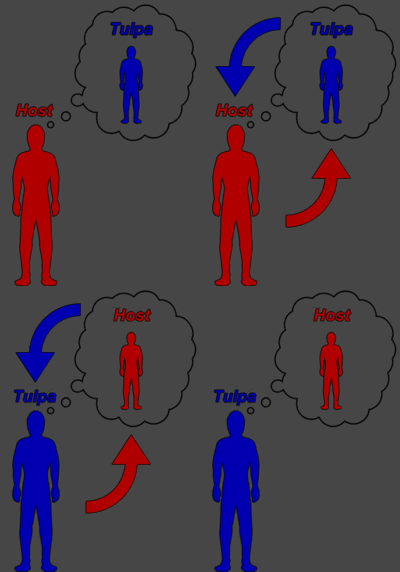
Switching is the process of two consciousnesses exchanging sense of agency and sense of ownership over the body and thoughts. Switching typically refers to the host (or "tulpamancer") temporarily exchanging places/roles with their tulpa. The tulpa is elevated to being the primary consciousness and ego while the tulpamancer becomes a secondary consciousness.

Switching is uncommonly reported with the tulpamancy community; this is perhaps due to its advanced nature, as it incorporates aspects of visualization, dissociation, and possession. However, switching is reported in people with natural multiplicity or DID, as such it may be contingent on sufficient development by tulpa or a natural affinity for it. While in the switched state, seemingly the result of being the secondary consciousness, the host may experience a range of effects including thought deceleration, depersonalization, derealization, ego death, internal hallucinations, and/or tactile disconnection. It is possible for this state to cause the tulpamancer to experience black outs or amnesia, as a result of losing awareness during the experience. The tulpa will may experience thought acceleration, ego inflation and a range of cognitive enhancements as it becomes the primary consciousness.

From the hosts perspective, switching is capable of causing out-of-body experiences comparable to dreaming once the host is disconnected from their physical senses. This state is comparable to lucid dreaming, it is a hallucinatory state which ranges in vividness from partially to fully defined dreamstate. Entering this state is sudden, one may experience a disconnection from their physical senses accompanied by a breakthrough into an alternate, immersive reality of hallucination. One may lose lucidity or awareness in this state when maintained for an extended period of time. This state may vary in vividness from partially defined and blurry to nearly indistinguishable from reality.

Switching relies on ones ability to disconnect from their physical awareness while the tulpa assumes agency over conscious action and thought. Previous experience in meditation or lucid dreaming may prove beneficial for those seeking to experience this state. Switching appears to come naturally at a higher rate in people with natural multiplicity, however it can be trained in those who do not. It can be considered an advanced state of possession which includes aspects of dissociation and visualization. Compelling visualization ability will increase feelings of immersion while dissociation will help one drift away from physical perception.

The technique for reaching this state can be practiced by undergoing extended states of possession in combination with meditation techniques to quieten the ego and mental activity of the host.

When a host and tulpa switch regularly, they will notice an affinity for re-entering the state. Furthermore, this state can be triggered unconsciously or accidentally when the mind is familiar with it. This is especially common when one is sleep deprived or under the influence of hallucinogenic drugs.

The switching gradient

Partially defined switching

Upon entering the switched state (or sometime after), the host may enter a dormant state while not completely dissociating from their physical senses. The host can remain in this limited state which can gradually progress to almost the complete loss of all awareness of the body. While in this state, the host may experience a variety of cognitive suppressions (including ego death) and be rendered mostly inactive mentally. One may be unable to communicate without the attention of the tulpa or may resort to non-linguistic conceptual thinking to communicate. One may experience hypnogogia in this state, which is flashes of disorganized and weak internal hallucinations separate from physical awareness. Once reached, this level of switching can be compared to "waking sleep" from the perspective of the host. If this state is maintained for some period of time, one's tulpa may have to initiate or help end it.

Fully defined switching

This level is achieved when the host is completely dissociated from the physical body. If there is any awareness of the body, it is comparable to the perception of one's physical body when dreaming. The host may lose awareness in this state, resulting in a black out until something triggers them back into consciousness. This may initially be disconcerting for the host as one may not realize a black out occurred until emerging from one. Memory of the time the tulpa was in control may be blurry or non-existent. The use of meditation techniques may assist this process.

This level can occur nearly instantaneously. Accidental or triggered switches are often much faster in onset, accompanied by a quick disconnection from the physical senses. Internal hallucinations at this level are all-encompassing, detailed and dream-like. The disconnection from physical stimuli greatly increases immersion in wonderland. One may experience lucidity or dream-like plot acceptance, and may get distracted by the content of the hallucinations. These hallucinations may be well-defined yet lack the vividness of reality or lucid dreaming. One's sense of time in this state is distorted as one may drift out of lucidity or remain disconnected for several hours. Switching is generally experienced as comforting and serene. The duration and stability of this state is dependent on practice or natural skill.

Hypotheses for the mechanics of tulpas

While the exact mechanics on which tulpas work remain unknown, and the tulpa phenomenon remains scientifically unproven, the tulpa community has given rise to several popular speculative hypotheses that try to explain the mechanics that would allow people to experience the phenomenon.

The mirror neurons hypothesis suggests that mirror neurons may be responsible for allowing the brain to perceive a part of itself as operating as if it was a separate person. According to this hypothesis, a tulpa works on the same mechanism that allows humans to empathise with each other, and respond to feelings and actions we observe, as if they were our own. According to this hypothesis, a tulpa is created by constantly stimulating mirror neurons, until they form advanced networks of their own, capable of acting on their own volition.

The simulatory mind hypothesis suggests that basic thought, imagination and hallucinating or dreaming are all essentially a result of the same mechanism rendering data at different levels of detail within a neurological simulation framework system which exists to mirror the external environment by categorizing the sensory input it receives into a database of "separate" concepts and subconcepts in order to later use these for the processing of ideas and thoughts.

Assuming this is true, one's inner mind's eye could be thought of as a computer simulation framework which uses its internally stored memories to render concepts and ideas at varying levels of detail. Although the detail at which this renders concepts during everyday living is usually low, during dreams and hallucinations this system is capable of generating data that is detailed enough to be hyper-realistic and indistinguishable from waking life. This includes the ability to generate autonomous entities which are fully capable of coherent conversations and not unlike that of tulpas. It could perhaps therefore be extrapolated that those who are experiencing tulpas, have deliberately strengthened their control over this framework through a combination of persistent practise and perhaps even neuroplasticity to perform the specific task of simulating an ever present autonomous entity without the need for dreaming or hallucinogens.

It's worth noting this hypothesis provides tulpas as a concept with the option of another linguistic title which is similar in meaning and has the potential completely to replace it. The aforementioned word is "simulant" or "simulants" instead of "tulpa" or "tulpas". It could perhaps be considered as a viable alternative by the tulpa community at large as a legitimate term which is more precise in both its meaning, respectfulness and relevance.